




In a disciple’s life, pictures of the Master are a natural part of the home. But a passing glance at a photograph on the wall is one thing. Deep contact with a picture is another: then you can connect with the Master’s consciousness.
For years, his face was with us every day. Not in a frame on the wall, but on the screen in front of us, in hundreds and then thousands of photographs: laughing, silent, deep in meditation, looking straight into the camera. Later it was no longer only on the screen. With closed eyes I saw it before me, and in time, when I meditated, I felt his face on my own. Somewhere in those years, Andi and I noticed that we were no longer only studying a face. The face was teaching us something.
The recognition
Sri Chinmoy wrote in many places about the power of divine compassion, and about how it works and shows itself through the face. Among his photographs there are some taken when he sat specifically as a model for sculptors, so that through statues he could be preserved for the future. When I looked at them, the power flowing from his face was unmistakable. It was compassion. That was the moment of recognition.
For more than ten years, Andi and I have worked as digital marketers, and for all that time we have helped to share Sri Chinmoy’s philosophy and teachings, online and offline. Our work has taught us to look for bridges: to understand what happens inside people, and how they respond to what they see. Sri Chinmoy was a spiritual Master, and also a philosopher of peace, a poet, a painter, and an example to people of many different faiths. Yet the mind, when something is unfamiliar, does not always meet it without preconceptions. The dhoti he wore, the folded garment of India already seen in depictions nearly 4,500 years old, can be such a threshold for someone who has never seen it. Sometimes the mind forms its opinion before the heart has had a chance to open.
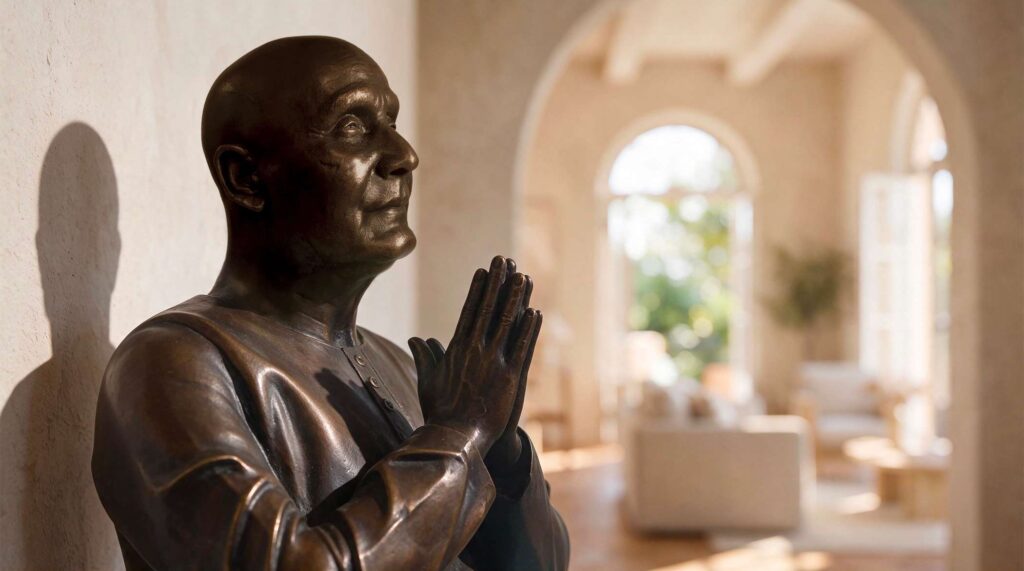
From this came the idea. If compassion, the greatest divine power, lives in the expression of the face, then the portrait bust, a form people have accepted for thousands of years, could let that compassion receive undivided attention. The rounded form beneath the bust was inspired by a globe: the earth, our shared home, where peace will one day blossom through the transformation of each individual.
What Compassion is
Compassion is our bronze bust of Sri Chinmoy. It is made in two sizes: life-size, 64 cm on a natural marble base, for meditation places, galleries and public places, and 15 cm for the home. Both carry the same face, modelled from thousands of photographs and film frames, cast in traditional lost-wax bronze and patinated by hand.
Why we called it Compassion
Sri Chinmoy spoke of compassion again and again, and always as something real and alive, never as an idea. Asked what God’s greatest power is, he answered: “God’s greatest power is His Compassion.” When compassion and justice meet, he said, “ninety-nine out of one hundred times His Compassion wins.” And man’s greatest power? “Man’s greatest power is his gratitude.” (Creation and Perfection)
On 29 May 1978, in New York, after a meditation in which he brought down only compassion, he told his students: “Of all the Powers the Supreme has, His Compassion-Power is the most powerful Power.” And he added that when we receive it and value it, “everything in us can be illumined, no matter how long it has remained in darkness within us.” (His Compassion Is Everything To Us)
We read these lines many times while working on the bust. They did not make the work easier. But they reminded us what we were trying to serve: not a likeness for its own sake, but a face through which so much compassion had flowed into so many lives, our own included.
A gaze that gives
The hardest part of any face is the eyes. In his, it was the softness around them, the way they seemed at once far away and very close. In the life-size bust we worked out even the pattern of the iris. But a gaze that carries a deep state of consciousness also needed the right closing distance of the eyelids, and finding it made the work technically very hard: between the lids there is very little room for the tools. This is most true of the smaller statues, but at every size it is far more demanding than shaping wide-open eyes. And if you look closely, the gaze is never quite the same in two of our statues. However precise and unchanging the mould, the metal seems to shape its final appearance a little by itself.
Sri Chinmoy described the meeting of Master and disciple as an exchange of light “transmitted through the eyes”: “The Master looks at the disciple with soulful Compassion and the disciple looks at the Master with soulful adoration.” (The Vision of God’s Dawn) And he once said that God’s Compassion-Eye “acts like a magnet”, pulling into itself the suffering and weaknesses of human beings. (Sri Chinmoy Answers, Part 5)
A statue cannot look at anyone. We know that, and we would never claim more for our work than it is. But we tried, with all the care we had, not to stand in the way. If someone sits before Compassion and, for a moment, remembers that gaze, then the bronze has done what we hoped.
Through the form, towards the formless
Why a face at all, when what we seek is beyond every form? Sri Chinmoy answered this simply. “When you meditate, it is always better and safer to meditate on the form,” he said, and: “You will feel that if you can see a thing, you can grow into it.” (God-Life: Is It a Far Cry?) Elsewhere he put it in one sentence: “So the seeker can take the form as an expression or manifestation of the formless.” (The Vision of God’s Dawn)
This is how we understand a bust. The face is where the form comes closest to what lies beyond it. A vast, formless compassion can feel too abstract for the mind to hold. A face it can hold. And from the face, the heart can go further on its own.
Learning his face
How we work on a likeness, with thousands of photographs, digital sculpture and clay, we have told in How we create a faithful likeness of Sri Chinmoy. For Compassion, the face went through four main versions and countless stages in between. The third became the one we transformed into noble materials. It meant months of returning to the same few details: the arch of the brow, the eyelids, the stillness of the mouth.
Millimetres decide everything in a face. A few small, almost invisible changes in the arrangement of the features, and you begin to see someone else. And this goes beyond textures. One of the last stages of a truly lifelike face is to work out its real imperfections and asymmetries. In traditional sculpture, perfect symmetry, long seen as the source of a face’s beauty, is very hard to achieve; in digital sculpture it is almost effortless. Yet if we look honestly at our own faces, we find many asymmetries in them.
So we decided early on not to smooth his face into an idealised, polished look, however easy that is to achieve in metal. Instead, with careful control at every stage, we tried to show his face as it truly was, with every asymmetry we could depict: the tenth-of-a-millimetre differences between his eyelids that appear again and again in his photographs, the characteristic veins, the small marks and scars of the skin. Everything our abilities and our eyes allowed, we rendered as faithfully as we could. Shaping the pores and the structure of the skin asked for real patience.
Some metal specialists told us that such detail is impossible to show in bronze. From Sri Chinmoy we learned that impossibility does not exist. It takes a great deal of extra work, technical development, and patience with castings that do not succeed. But that, as they say, is art.
And then, one day, it was no longer we who were looking at the face. Something began to look back at us.
The day it arrived
The head of the life-size master model of Compassion was made for us by a technology partner in Western Europe, the company that develops and owns the process. It did not come easily. Twice the work failed in the same strange way: each time, half of it was simply missing. The specialists, who had made countless such pieces, could not understand how it could happen. Only on the third attempt, about a year after the first, was it finally born whole. Looking back, it felt as if something had been resisting its arrival.
When the package came, carefully packed and sent with priority, I was alone in the studio. I opened it slowly and lifted the head out. And I had to put it down at once. A strong, deep, meditative energy was flowing from it, so strong that for almost an hour I could do nothing but look at it and feel it. Around it there was something I have experienced only very rarely: a radiant envelope of energy. It was as if silence itself had become something you could touch.
I was so moved that I wanted Andi to meet it in the same way, alone and unprepared. So I placed it in her workroom as a surprise. Andi is someone who is almost always cheerful, always ready with a joke. But when she came out, her face was completely still and serious. She said something like this: “What has been born here… We are just lucky souls to have anything to do with it.”
The chest came much later. It had to be assembled from several parts and worked out by hand, until head and chest became one bust.
From wax to bronze
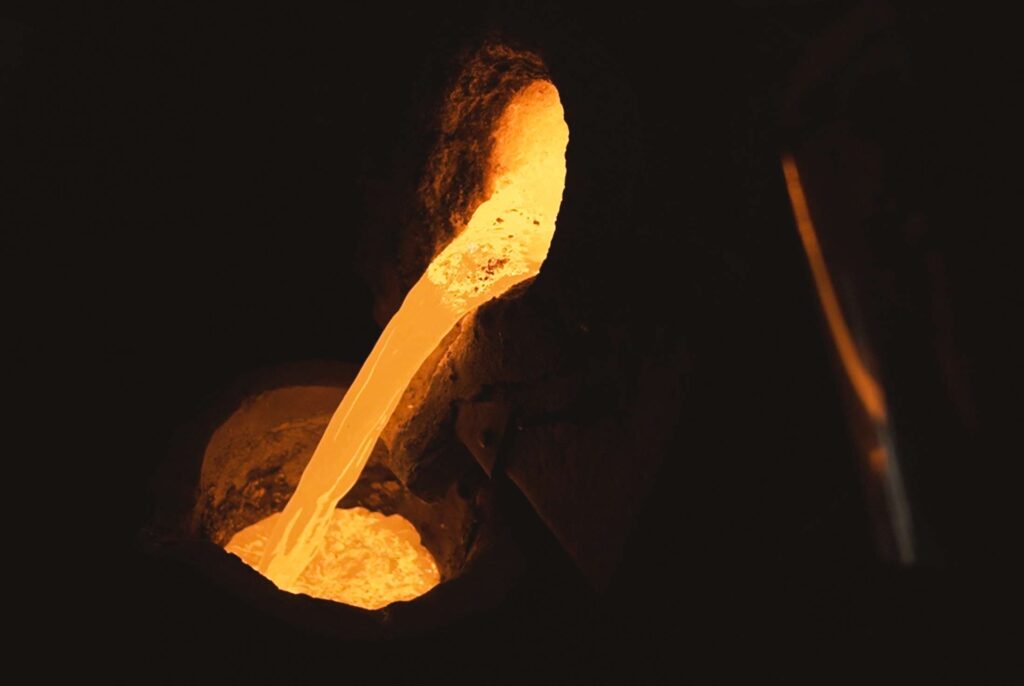
As I write this, the life-size master model is complete, and its journey into bronze has begun with the making of the moulds. Then come the hollow wax copies refined by hand, the ceramic shell, the fire, the molten bronze, the chasing and, last of all, the patina. Seven crafts and many hands take part in it, and we follow every step as closely as we can. (How long each step takes, and why it cannot be hurried, we tell in How long does it take to make a bronze statue?)
We have been part of the birth of so many bronzes by now that we can foresee quite precisely what the metal will be able to show. The visualisations of the finished life-size bust are already published. We are waiting for the bronze with quiet joy.
Two sizes, one face
The life-size Compassion, on its marble base, is made to be met face to face, in a place where many people come and go. The 15 cm Compassion carries the same studied detail in a size that can be held in two hands, for a desk, a shrine or a bedside table. Whichever size someone chooses, the face is the same.
Those who stood before it
At exhibitions, we have seen it with our own eyes more than once: someone stops before one of our small bronzes of Compassion or Aspiration, and after a while begins to cry, tears of joy, receiving an inner experience they felt came from the Master himself. And one of our fellow disciples first met these statues as a seeker. They moved her so deeply that, in time, she chose the Master’s path.
Wherever Compassion stands, we hope it does one quiet thing: that whoever passes before it receives a little of what we received while making it. And that, in return, something in them answers with the gift Sri Chinmoy called man’s greatest power: gratitude.
Questions about the Compassion bust
What is the Compassion bust?
It is our bronze bust of Sri Chinmoy, cast in traditional lost-wax bronze and patinated by hand, modelled from thousands of photographs and film frames.
Why is it called Compassion?
Because compassion was the quality we felt most in his face while making it. Sri Chinmoy taught that “God’s greatest power is His Compassion.”
What sizes is it made in?
Life-size, 64 cm on a natural marble base, made to order in two to three months; and 15 cm, available now in a brown or turquoise patina or a polished golden finish, in a wooden presentation case.
Can Compassion be made for a Centre or a public place?
Yes. The life-size bust was conceived for such places, and we advise on the base, the height and the light.
References
- Sri Chinmoy, Creation and Perfection, Agni Press, New York, 1976, cap 8 – srichinmoylibrary.com/cap-8
- Sri Chinmoy, His Compassion Is Everything To Us, Agni Press, New York, 2013, hce 31 – srichinmoylibrary.com/hce-31
- Sri Chinmoy, The Vision of God’s Dawn, Agni Press, New York, 1974, vgd 9 – www.srichinmoylibrary.com/vgd-9
- Sri Chinmoy, Sri Chinmoy Answers, Part 5, Agni Press, New York, 1995, sca 160 – srichinmoylibrary.com/sca-160
- Sri Chinmoy, God-Life: Is It a Far Cry?, Agni Press, New York, 1974, gl 30 – srichinmoylibrary.com/gl-30