




When I was a small boy, I discovered that if I held a sheet of paper against the window pane, the daylight would show me the lines of the drawing underneath. I could follow them with my pencil. I still remember the quiet joy of it: something I loved appearing again, line by line, under my own hand.
I did not know then that one day I would spend years doing almost the same thing, with the face of my spiritual teacher.
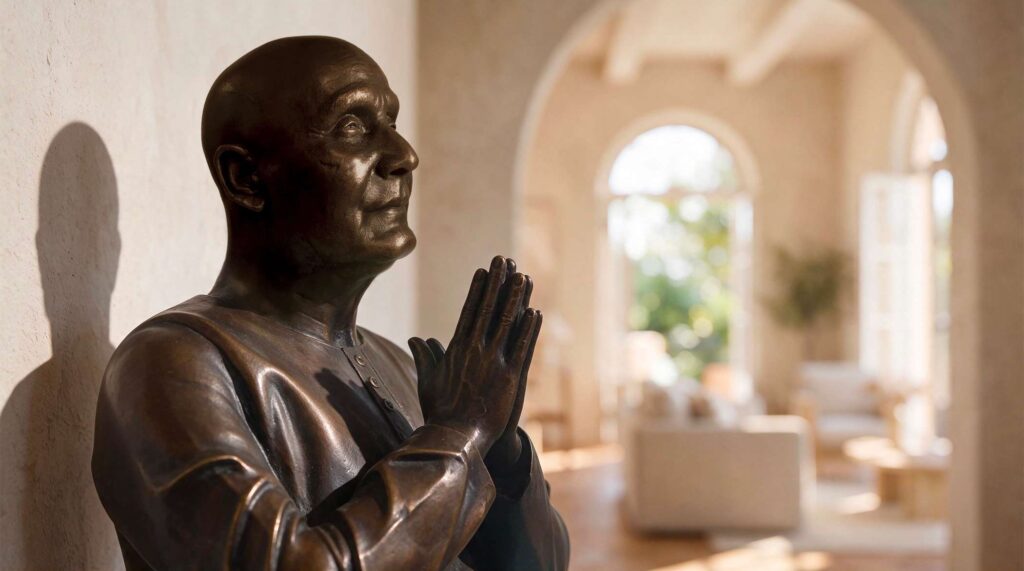
That is how each of our statues of Sri Chinmoy begins: with thousands of photographs and hours of film, studied over many years. The face is shaped digitally and then by hand, compared again and again with archival images, and finished only when it feels true to the heart. Creating our two models, Compassion and Aspiration, took seven years.
A face we carried in our hearts
As students of Sri Chinmoy, Andi and I gathered thousands of his photographs and many hours of film. Over the years they stopped being an archive. They became part of our lives.
Thanks to the love of his students, so many images of him exist. And yet each photograph tells a slightly different story. Light, lens and angle all change a face: in the very same instant, one lens makes it look fuller, another narrower. That is the beauty of photography. For someone trying to shape a face in three dimensions, it is also a gentle trap. So we learned patience with the details: the arch of the brow, the eyelids, the curve of the nose, the way his hands rested on one another. We trusted a detail only when many images agreed on it.
Why likeness matters to a seeker
I have never stood before a statue of Sri Chinmoy in which I did not feel his presence. I believe that whenever someone shapes his form with devotion, he places something of himself in it, and anyone who lets the mind grow quiet will feel it.
For us, likeness is simply a way of serving the seeker. Many people who will stand before a statue in a park or a meditation room never met him. For some, it will be the first time they see his face at all. When the face before them is close to the face in his photographs and films, the mind can rest a little sooner, and the heart can come forward.
When disciples travelled from far away to see him, Sri Chinmoy said that “the Master’s physical presence helps to convince the disciple’s physical mind.” (The Avatars and the Masters) A statue is not his presence. But we hope that, in a humble way, a faithful likeness can help a seeker’s mind in the same direction.
He also once said that “the face reveals what the heart is; the heart is what God gives.” (Consciousness: God-Journey to Man, Man-Journey to God) Perhaps that is why we keep returning to the face.
Learning, one return at a time
We shape each statue first in digital sculpture and then in clay. Working digitally is not easier. It is more precise, and more forgiving: a wrong movement can be undone. It also has its own trials. More times than we can count, we lost days of work to a technical problem and simply began again.
Our first physical version looked like a plastic doll with a stretched face. It was a humbling moment, and a necessary one. We went back to the drawing board, again and again, working on it together, until the day came when the finished form needed only a little clay and a few traditional tools.
And then the window pane of my childhood came back. In digital sculpture, the form can be made transparent, so that the photograph shows through it. Angle by angle, photograph by photograph, the face slowly settles into the lines we have known for so long.
Those years taught us something about patience. Sri Chinmoy described the seeker as a farmer who sows the seed, waters it and waits: “He must not become impatient and dig up the seed because he cannot see any plant.” (Sri Chinmoy Answers, part 22) Some parts of the face took months. We learned to let them grow.
When the form becomes physical
Even on the screen, the work carries a strong energy. But when the statue takes physical form, something new arrives. Details and impressions appear that looked different before, and we return to them once more, by hand.
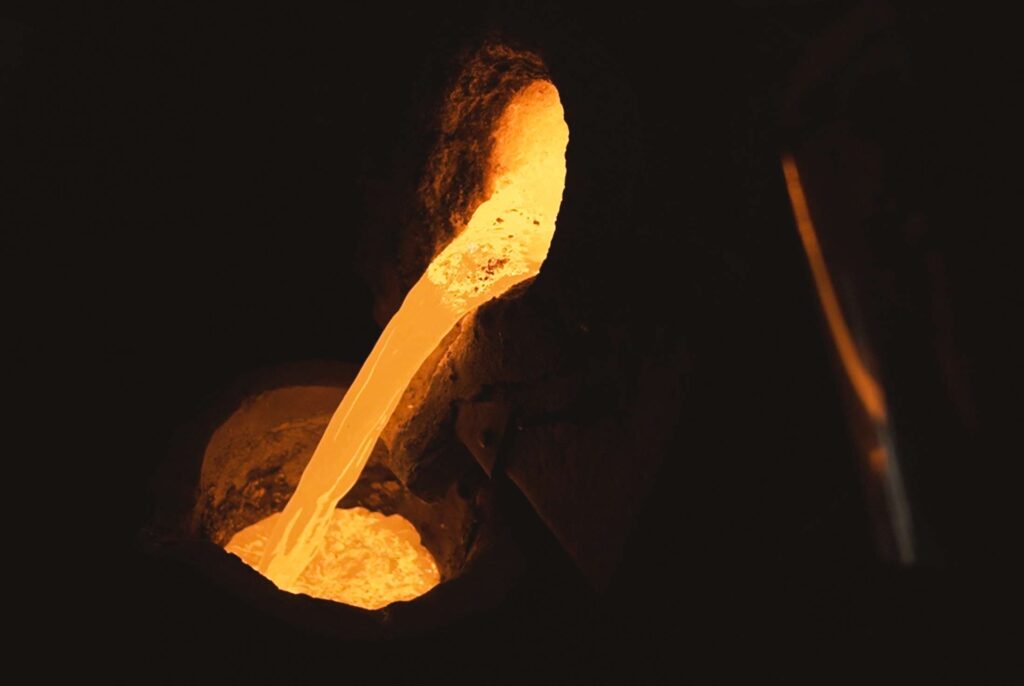
The change happens within a few days, and so it can be felt very clearly: as if a consciousness that was waiting has now entered the material. Each time, it moves us. We tell one such moment in the story of Compassion, and how the model then becomes bronze on our page about the craft.
The last step belongs to the heart
Measurements can make a face correct. They cannot make it alive. So the last step is not technical at all. We sit in silence before the statue and ask one simple question: does it carry what we felt in his presence, and in his films?
Sri Chinmoy wrote: “The mind power is perception power. The heart power is identification power.” (Earth-Bound Journey and Heaven-Bound Journey) The mind can check a line. Only the heart can recognise him.
Every statue is still a learning for us, and a gift we receive while making it. On each of our product pages you can move a slider between the statue and the photograph it was modelled from. And if you ever stand before one of them, we hope you will not think about lines and proportions at all. We hope you will simply feel him there.
Questions about likeness
How is a Sri Chinmoy statue made to look like him?
Each statue is modelled from thousands of photographs and hours of film, shaped digitally and in clay, and compared with archival images at every stage.
Can I compare a statue with the original photograph?
Yes. Each product page has a slider that moves between the finished statue and the archival photograph it was modelled from.
How long did it take to create the models?
Our two models, Compassion and Aspiration, took seven years to create.
References
- Sri Chinmoy, The Avatars and the Masters, Agni Press, New York, 1979, am 10 – srichinmoylibrary.com/am-10
- Sri Chinmoy, Consciousness: God-Journey to Man, Man-Journey to God, Sri Chinmoy Lighthouse, New York, 1974, gjm 40 – srichinmoylibrary.com/gjm-40
- Sri Chinmoy, Sri Chinmoy Answers, Part 22, Agni Press, New York, sca 772 – srichinmoylibrary.com/sca-772
- Sri Chinmoy, Earth-Bound Journey and Heaven-Bound Journey, Agni Press, New York, 1975, ebj 5 – srichinmoylibrary.com/ebj-5