
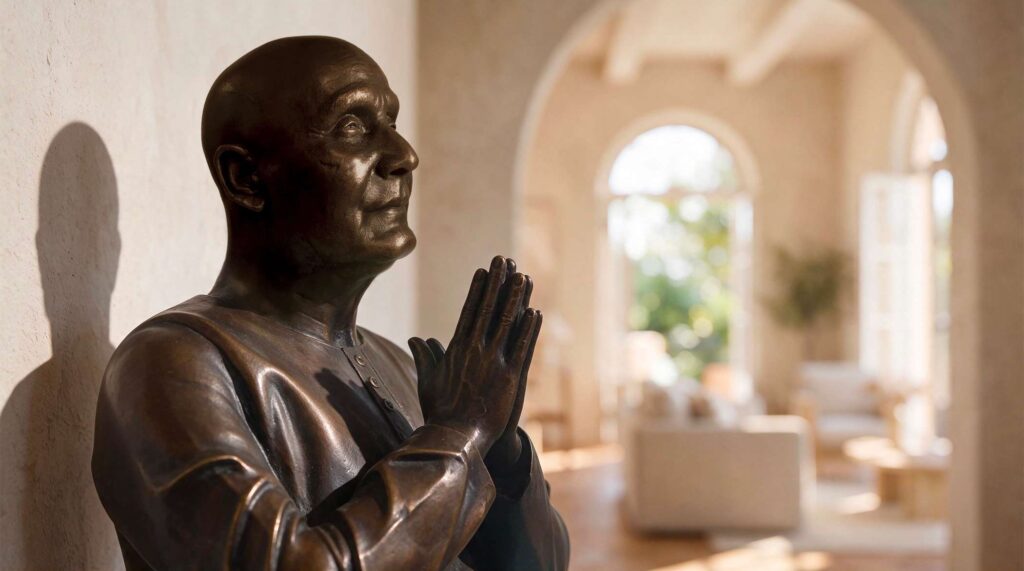



In many Buddhist and Hindu traditions, a sacred statue is made within rituals. Each stage of its making is accompanied by ceremony, so that the image is ready to receive what it is meant to carry.
Our statues are not bound to lengthy ceremonies. Yet something of that same attention is present in every phase we take part in. From the moment the statue has not yet even taken form, we look on it as a vessel being born, one that is meant to carry a consciousness, and we try to connect with it inwardly. Not through outward ritual, but in a quiet, natural way: sometimes stopping for a few minutes to meditate on it, sometimes in the middle of the work itself. And when an important step is taking place far from us, at one of our partners, we know when it is happening, and we include it in our daily spiritual practice.
This is one reason why a statue cannot be hurried. People often ask us the same question, and it is a fair one: why does a statue take months, when so much in our world now arrives in a few days?
Seven years behind every statue
The longest part of the work is already behind us. We have been devoted to this project for seven years, and the first orders came two years into it. Since then, the experience of every statue has been built back into our processes. While creating our two models, Compassion and Aspiration, we met many challenges, both in our own limits and in the limits and processes of our partners. So when someone orders a statue today, no one has to wait for the face to be born. What remains is the metalwork and the casting: the slow, physical journey in which wax becomes bronze.
Where the time goes
A bronze statue of Sri Chinmoy from our studio takes two to three months, from order to finished work. The models already exist, so the time goes into the casting and the metalwork itself, all of it done by hand. Our smaller bronzes, made in limited editions, are available now.
- The mould and the wax. A flexible mould captures every form and detail of the master work. Hollow wax copies are made from it, then refined and retouched by hand.
- The ceramic shell. The wax is dipped five to ten times into a fine ceramic slurry and dusted with sand. Each layer must dry for hours, and then the shell may rest for as long as a week to dry fully and naturally.
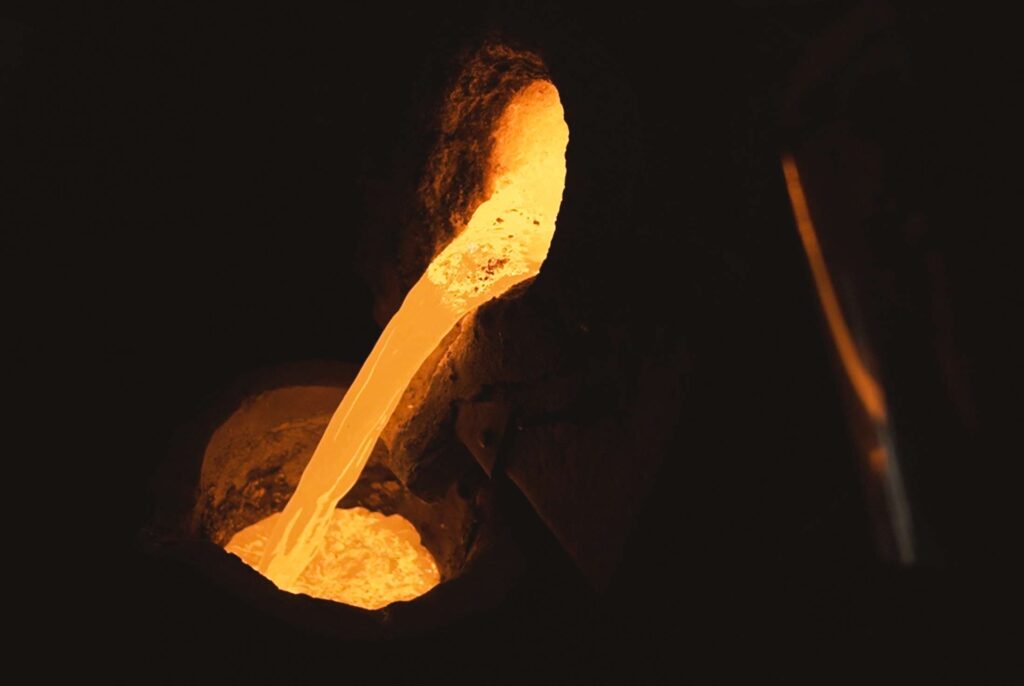
- Fire and bronze. In the kiln the wax melts away, and molten bronze at over 1,000 °C is poured into the empty shell. Cooling takes hours, sometimes days.
- Chasing. The shell is removed, the parts are worked and joined, and every detail and line of the statue is restored by hand.
- The patina. The colours are brought out with fire and patina solutions, layer by layer, and finally sealed with wax.
None of these steps can be shortened without harming the work. Wax that is rushed loses its precision and its detail; a shell that has not dried can crack in the fire; a patina laid on in haste is less beautiful and less lasting. Sri Chinmoy put it in a single line: “Aspiration has an enemy called impatience.” (Eternity’s Breath)
How we protect your date
We do everything in our power to keep to the agreed time. Over many years of making statues, we have learned where things can slip, and we prepare for each of them in advance:
- The mould. The quality of a wax mould decides the quality of the statue, so making one is long, meticulous and complex work. One of our moulds can consist of as many as nine parts that fit together with perfect precision. We use the finest materials, so our moulds serve us for many years, and many wax statues can be cast from them, even by our own very high standards. When a statue is chosen for which no mould exists yet, or the existing one is worn, making a new one can take months. For projects with a strict deadline, we always account for this and build in a safety window.
- The casting. For critical deadlines, we start a second, parallel casting as a safeguard. If a casting fault cannot be corrected, a reserve piece is ready, and weeks or months of work are not lost. This means double work and investment on our side, so in these cases we ask for full payment in advance, within a time window set out in a separate agreement.
- Peak seasons. Some periods of the year, such as the end-of-year holidays, are especially busy, and capacity is limited. We plan these periods with particular care.
- Large projects. While a project bound to a deadline is under way in our studio or with our partners, we do not take on further work that could put its completion at risk.
- Out of studio. There may be periods when we do not accept new commissions, because of other projects, holidays, travel or other reasons. We count on these from the start and set the dates together with you.
- The unforeseen. Illness, a temporary shortage of materials, or a special request that needs a solution: we build reserve time for all of these into every deadline in advance.
Over the years we have learned that it is better to set a longer time than to let enthusiasm put a deadline at risk. This is why the delivery date we confirm in writing already includes this reserve, so that everyone can be at peace about the final date.
Sri Chinmoy once said: “Patience is something that lengthens time.” (Sri Chinmoy Speaks, Part 4) For us, the reserve time is exactly this: patience planned in advance, so that the date promised to a community, or to a family celebration, can be kept.
We count ourselves fortunate. We have created statues for several family occasions where the date was set in stone. Some of our clients later shared with us videos of the handover, at a birthday or an anniversary: the tears of joy, the atmosphere that welcomed the statue. These are priceless treasures for us.
Planning an unveiling
For a public statue, the casting is rarely what takes longest. Choosing the site, obtaining permission and building the base usually take more time, often much more, than making the bronze itself. So we suggest a simple order: begin the conversation with the city early, agree on the design (we can also provide visualisations for this), and set the unveiling date only once permission has been granted. In the same talk, Sri Chinmoy described patience as “our conscious surrender to the Hour of God.” (Sri Chinmoy Speaks, Part 4) An unveiling that waits for its right moment loses nothing.
Seeing the statue grow
Waiting is easier when you know where you are on the way. During the making, we send you short status updates with photographs at the key stages: the wax, the casting, the chasing, the patina. Each one marks a step behind you, so you can feel the day of completion coming closer.
What the waiting gives
Patience, Sri Chinmoy said, is “something that extends our time limit.” (Sri Chinmoy Speaks, Part 4)
A statue that has taken months to make will stand for centuries. Seen from that distance, a few weeks of patience are a small part of its story, and perhaps the first gift it gives: the experience of waiting for something worthy, together.
Questions about timing
How long does it take to make a bronze statue?
Our bronze statues take two to three months from order to completion. The smaller bronzes are available now and reach addresses within Europe in about three days.
Can a statue be ready for a specific date?
Yes, if the order is placed early enough. We plan every statue with reserve time built in, and confirm the delivery date in writing. For public statues we suggest setting the unveiling once permission has been granted.
Will I see the statue while it is being made?
Yes. We send photographs at key stages of the work.
References
- Sri Chinmoy, Eternity’s Breath, Sri Chinmoy Lighthouse, New York, 1972, etb 40 – srichinmoylibrary.com/etb-40
- Sri Chinmoy, Sri Chinmoy Speaks, Part 4, Agni Press, New York, 1976, scs 90 – www.srichinmoylibrary.com/scs-90