




As a young child, I sometimes visited museums and exhibitions, among them exhibitions of ancient Egyptian and Greek art. I still remember the silence that met me in front of those works. They were made so long ago that even now, as an adult, the mind can hardly grasp the distance of the time that has passed. Someone with hands like mine shaped them thousands of years before I was born, in a world I can only hear stories about, but can never touch or feel. And yet they were there, and I could stand before them. Ever since, I have been deeply moved by that particular silence of museums, and by the presence of works made thousands of years ago.
These works were not created only to be admired. Their purpose was to preserve something and to pass it on: a message about what, or who, mattered most to those who once made them. Thousands of years later, that message still arrives. Standing there, I often felt that I was not looking at an object at all, but receiving something that time seemed to have kept just for me. And there are many such works in the world, giving the spirit a timeless form.
One of them is not in a museum. It sits under the open sky.
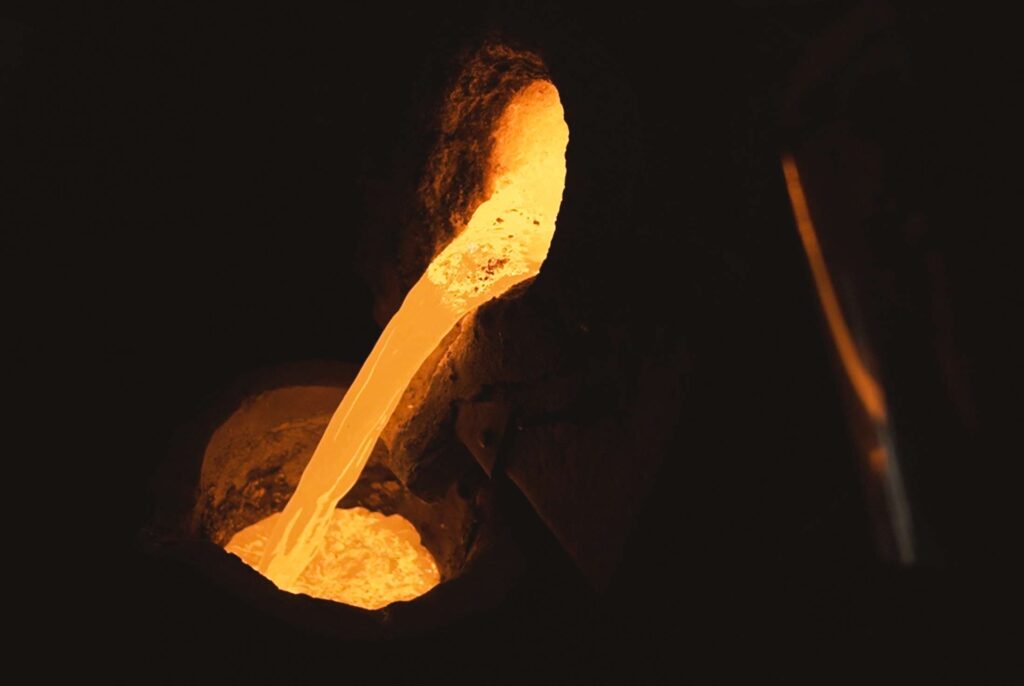
More than seven and a half centuries ago, in Japan, molten bronze was poured into the mould of a great Buddha. Its makers could not have known who would one day come to sit before it.
For generations it stood inside a wooden hall. Then, in 1498, the sea came. A tsunami swept the hall away, and the Buddha remained, with the same infinite consciousness, under the open sky. It is still there today. Rain runs down its shoulders, snow settles in its folded hands, and its bronze has taken on the soft green of old leaves. More than five hundred summers have passed over it, and it has remained unmoved. (Lonely Planet)
In the early 1900s, the Mother of the Sri Aurobindo Ashram and Rabindranath Tagore also stood before it. Almost a century later, in March 1992, Sri Chinmoy came here, and he remembered them: “They stood and meditated at the exact place where we stood and meditated.” This statue was dear to his heart. “My most favourite statue is the Kamakura Buddha in Japan,” he once said. “There I see and feel Lord Buddha’s living presence.” (You Belong to God) And standing in that garden, he spoke the words that have stayed with us ever since: “Lord Buddha will remain here, generation after generation.” (You Belong to God)
Generation after generation. When Andi and I had to choose the material for our statues, this was exactly the feeling we were looking for. Not only a precious object, worth owning because it holds its value, but something that can stay in one place long enough for generations to come to it.
Searching for the right material
Over the years we made statues in many materials, searching and researching, and bringing experienced masters of each craft into our project. Each material taught us something. Stone is wonderfully enduring, yet it wears, cracks and crumbles. Fired ceramic is remarkable, like glass, but it needs very careful handling to keep its form over time. Wood decays, concrete turns to dust, and resin and plaster are not made for such long spans of time.
But durability was only one consideration. Energy was another, and an even more important one. So we placed the finished works side by side, and we meditated, watched, and meditated again. The feeling led our choices towards the noble materials. And bronze proved outstanding in every respect.
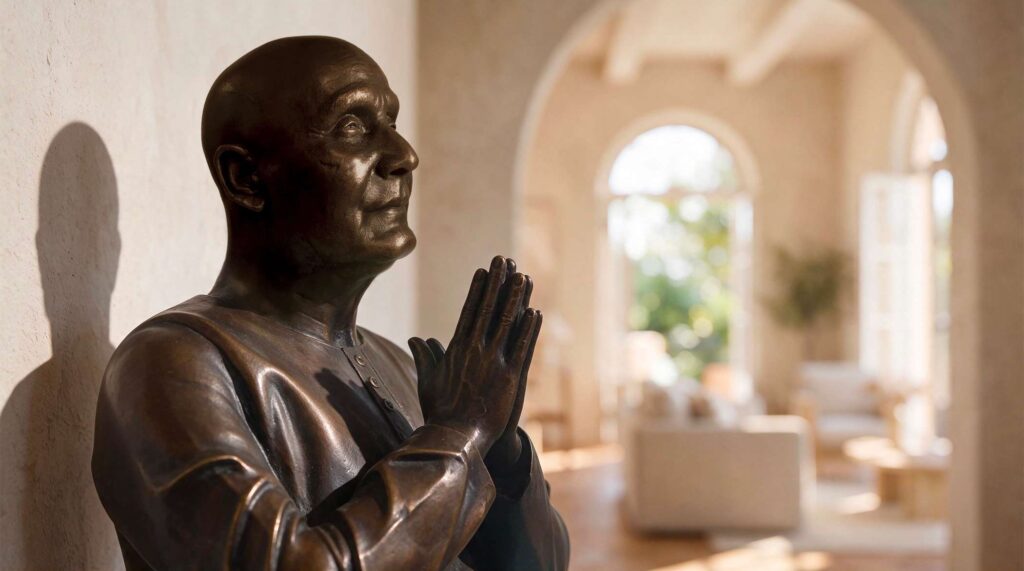
The Bhagavad Gita says of the soul that wind cannot dry it and water cannot wet it. Bronze is not immortal or eternal. But on the scale of matter, it comes closest: bronze statues cast in antiquity still stand today, because the metal does not rot, crack or fade. Bronze endures. This is why we cast our Sri Chinmoy statues in bronze.
The Kamakura Buddha is one of the finest examples of bronze as a guardian of consciousness across generations. When people wish to leave something truly lasting and unchanging to the future, bronze stands first among the noble materials. And so it holds a special place among our works.
The vessel, not the treasure
It would be easy to speak of bronze as if it made a statue eternal. It does not. Sri Chinmoy taught that “when we speak of immortality, it is the immortality of consciousness that we are referring to.” (Miracles, Emanations and Dreams) The bronze is only the vessel. What it will carry, the presence felt by those who stand before it, is not the artist’s merit. The artist’s part is only the skill to make the vessel as fit as possible for the purpose for which it was born.
And yet the vessel matters. Asked why one can feel love in a church, Sri Chinmoy answered simply: “It is because thousands of people have prayed there for many years.” (Miracles, Emanations and Dreams) A statue that can stand in the same place for centuries becomes such a place itself. Every meditation, every flower, every quiet moment spent before it can remain in it, entering that infinite consciousness of which the precisely shaped metal can carry a part.
Bronze in the open air
Outdoors, the surface of bronze slowly answers the air and the rain. Year by year it forms a patina: a thin, stable layer that protects the metal beneath it. Its colour deepens and softens. A bronze statue is worth protecting from the weather, but it does not need to be; we might even say it grows into its surroundings, as the Kamakura Buddha has grown into its garden.
Of course, our aesthetic tastes differ, and as part of our care, regular protection with wax is a form of human attention, like bringing fresh flowers. Over the generations, though, the bronze does not depend on it to endure.
Seven crafts, and our own hands
A bronze statue is the shared work of seven crafts: sculptors, mould-makers, wax artisans, ceramic mould makers, foundry masters, goldsmiths and patina artisans. The technique we use, lost-wax casting, is more than six thousand years old. Each statue usually takes two to three months, and every hour of it demands skilled handwork.
For us, the birth of a bronze work does not end with finishing the model from which the craftsmen can work. We take part in the actual making of the bronze as closely as we possibly can. From the wax to the retouching and the patina, we try to take our share in every step, and to contribute to the final work with the work of our own hands and our careful attention.
An often-shared saying among artists puts into words something every maker knows: “When buying from an artist/maker you’re buying more than just an object/painting. You are buying hundreds of hours of failures and experimentation. You are buying days, weeks and months of frustration and moments of pure joy. You aren’t just buying a thing, you’re buying a piece of heart, part of a soul, a moment of someone’s life.”
Behind our two models there are seven years of exactly this: hundreds of corrections, days of work lost and begun again, and quiet moments of joy when a face finally came alive. Whoever chooses one of our statues receives all of it, and at the same time makes it possible for us to continue, so that more statues can follow.
With a statue of Sri Chinmoy there is something more. It is not only the fruit of an artist’s years. It becomes an instrument of a consciousness that keeps working, long after its makers are gone, to make individual lives, and the world, a little more peaceful.
Those who will pass by
A statue in a public place gives something no price can measure: it meets people who never went looking for it. A mother with a pram. A runner on the morning path. A tired man on his way home, who sits down on the bench beside it without knowing why. Some will begin to choose that path again and again, “by chance”, because something there does them good, even if they could not put it into words.
Think of it simply. If only fifty people pass a statue each day, that is more than 18,000 encounters a year, and over one human lifetime, more than a million. Most of them will never know his name. But they will have stood, for a moment, in a quiet place that was made for peace.
And for some, the place will become more than a path. Over the years it may become somewhere people come on purpose: to sit, to meditate, to bring flowers, to recharge, and in time perhaps to come as pilgrims. A statue that stands for centuries gathers all of this, one quiet visit at a time.
The same is true of a small bronze on a shelf at home or in a meditation room. Today it is a daily companion in your meditation. One day it will be passed on, to a child, to a friend, to someone who has just begun to seek.
Whoever decides to place a statue is not making a decision for one year only. They become part of a legacy, and of a vision that transforms the world peacefully, a vision that thinks even of children not yet born. A faithful bronze likeness is not simply a tribute to a person. It is a presence that keeps reminding each new generation of the inner life. Seen from that distance, the time and the cost are shared across generations.
“In many, many parts of the world”
Sri Chinmoy once said: “Like the statues of the Lord Buddha, my statues will be found in many, many parts of the world.” (The Path of my Inner Pilot) Already today, many devoted hearts in many countries are thinking of how to preserve the Master for present and future generations, and are working to fulfil this vision. If our statues can be a tiny part of it, standing quietly in a park, a garden or a meditation room long after we are no longer here in this form, it means more than we could hope for.
For us, to be part of this legacy of Sri Chinmoy is a special privilege. What fills us with gratitude is not only supporting the work and the manifestation of the Master, but the process itself: the feeling that we can be part of a vision, and of a journey, which, defying the passing of time, will still carry the energy that has transformed our own lives too.
Perhaps, a hundred years from now, someone will sit before one of these statues, in a garden we will never see, and feel what Sri Chinmoy felt in Kamakura. Generation after generation.
Questions about bronze
How long does a bronze statue last?
Bronze statues can last for thousands of years. The Dancing Girl of Mohenjo-daro, cast by the lost-wax method around 2500 BCE, is about 4,500 years old. (Live Science) The Riace bronzes, two Greek warriors cast around 460–450 BCE, lay on the seabed for centuries before they were found in 1972. (World History Encyclopedia) And the Great Buddha of Kamakura, cast in bronze in 1252, has stood in the open air since 1498.
Can a bronze statue stand outdoors?
Yes. Rain and air form a protective layer, the patina, on the surface, and the colour slowly deepens over the years. A thin layer of wax every year or two keeps the surface even.
Why does a bronze statue take months to make?
Because the process brings together seven crafts, from the wax model to the patina, each done by hand. We take part in these steps as closely as we can, which is how we stand behind the final result. Our statues usually take two to three months, depending on individual requests.
References
- Sri Chinmoy, You Belong to God, Agni Press, New York, 2012, ybg 14 – srichinmoylibrary.com/ybg-14
- Sri Chinmoy, You Belong to God, Agni Press, New York, 2012, ybg 34 – srichinmoylibrary.com/ybg-34
- Sri Chinmoy, Miracles, Emanations and Dreams, Agni Press, New York, 1977, med 22 – srichinmoylibrary.com/med-22
- Sri Chinmoy, Miracles, Emanations and Dreams, Agni Press, New York, 1977, med 16 – srichinmoylibrary.com/med-16
- Sri Chinmoy, The Path of my Inner Pilot, Agni Press, New York, 2015, pip 41 – srichinmoylibrary.com/pip-41
- The Great Buddha of Kamakura – Lonely Planet – www.lonelyplanet.com/points-of-interest/daibutsu/1110107
- The Dancing Girl of Mohenjo-daro – Live Science – www.livescience.com/archaeology/dancing-girl-a-pint-size-statue-from-the-indus-valley-civilization-with-a-larger-than-life-presence
- The Riace Bronzes – World History Encyclopedia – www.worldhistory.org/Riace_Bronzes/